
By Caleb Callais, ccallais@nd3llc.com

Have you ever wondered exactly how the penetrant that you apply to a test part gets into the small openings of that part even if it must travel upside down. There is a good chance that you may have witnessed this phenomenon in other instances and just never realized it. It is the same way a plant can get water to travel from its root fibers up the stem, or water wicking up a paper or cloth towel. This process is called capillary action. It’s a natural phenomenon that happens to be the key to understanding how penetrant testing works.
So, what exactly is capillary action? It is simply the ability of a liquid (the penetrant in our test) to move into tight spaces without help from any external forces, like gravity. This is due to the adhesion and cohesion of the liquid. Adhesion is when the liquid likes to cling to solid surfaces whereas, cohesion is when the liquid molecules like to stick to each other. When a liquid’s attraction to a surface (adhesion) is stronger than its attraction to itself (cohesion), the liquid naturally climbs into small openings.
Penetrant testing relies entirely on capillary action to pull dye into cracks, seams, or pores that break the surface of a part, as long as the surface of the part is clean.
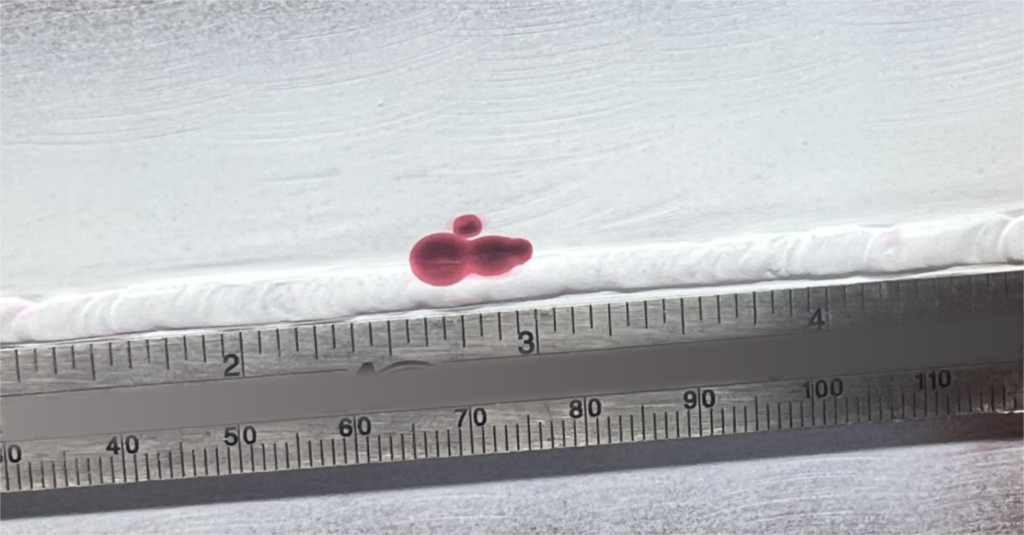
When a penetrant is applied, it spreads across the surface and immediately starts looking for places to go. Any surface-breaking flaw becomes a tiny “capillary tube,” and the penetrant is naturally drawn into it. This process however takes time to work. This period is what we refer to as the dwell time. During this period, capillary action is pulling penetrant deeper into the flaw. Wide or shallow voids will fill quicker than tight cracks, therefore proper dwell time is necessary for this inspection method to work properly and allow any fine discontinuities time to fill with penetrant.
After the proper dwell time has passed, the excess penetrant is removed from the surface but not from inside the flaws if very careful cleaning is performed. What we don’t want is to use all that time to allow the penetrant to get into these voids just to wash it away with sloppy technique.
Once the surface is cleaned properly, a blotting agent is applied; the developer. The developer can be a fine powder or a wet suspension of fine powder that will dry on the surface of the part. Much of the time, a wet suspension is used to thoroughly coat the part with an even layer. When applied, it creates a porous layer that draws the trapped penetrant back out of the cracks. This process is a blotting action and can be thought of as a capillary action. It also takes time to work. This period where we wait for the indication to show is referred to as blotting time.
Now, if done properly, even defects too small to see with the naked eye will often reveal themselves by the penetrant being drawn back out to the surface by the developer. So, yes, dwell time and blotting time does matter, stop getting in a rush. It’s typically only about 10 minutes for each, and most folks get paid by the hour. Apply your penetrant, set a timer in accordance with your procedure, and let capillary action do its work.